
Products
Inductorless, switching-free DC regulation in buck and boost topologies. Pick by current, noise floor, or radiation rating — evaluation boards are available for every part, with datasheets and SPICE models on request.
Four series, one architecture
Each family pairs a proven LDO core with Polaris PV-output optocouplers: pick the core that matches your constraint, keep the same switching-free architecture.
Every orderable part, one table
All specifications from the published product table and series pages. Parts are under development; specifications are subject to change. Unknowns are marked TBD — never estimated.
| Part | Topology | VOUT (V) | Max VIN (V) | Min VIN (enhanced) | Max IOUT (mA) | PSRR @ 1 kHz (dB) | RMS noise (µV) | TID krad(Si) | Package | LDO core | Docs |
|---|---|---|---|---|---|---|---|---|---|---|---|
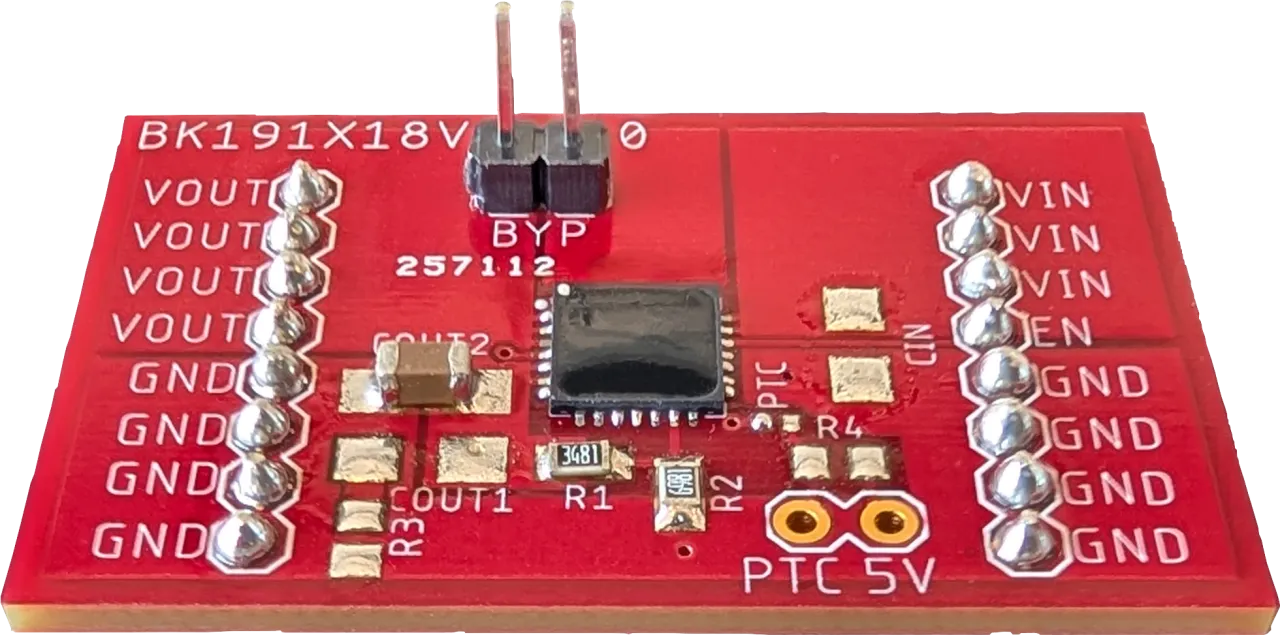
| BK191D18V | Buck | 1.2 – 2 | 20 | VOUT + 1.4 (L) VOUT + 2.8 (M) | 900 | 75 | 12 | 200 | QFN-28 · 6 mm | RH1965 | Spotlight |
| BK291D18V | Buck | 1.2 – 2 | 26 | VOUT + 1.4 (L) VOUT + 2.8 (M) | 1000 | 65 | 160 | 200 | QFN-28 · 6 mm | MIC29152 | Spotlight |
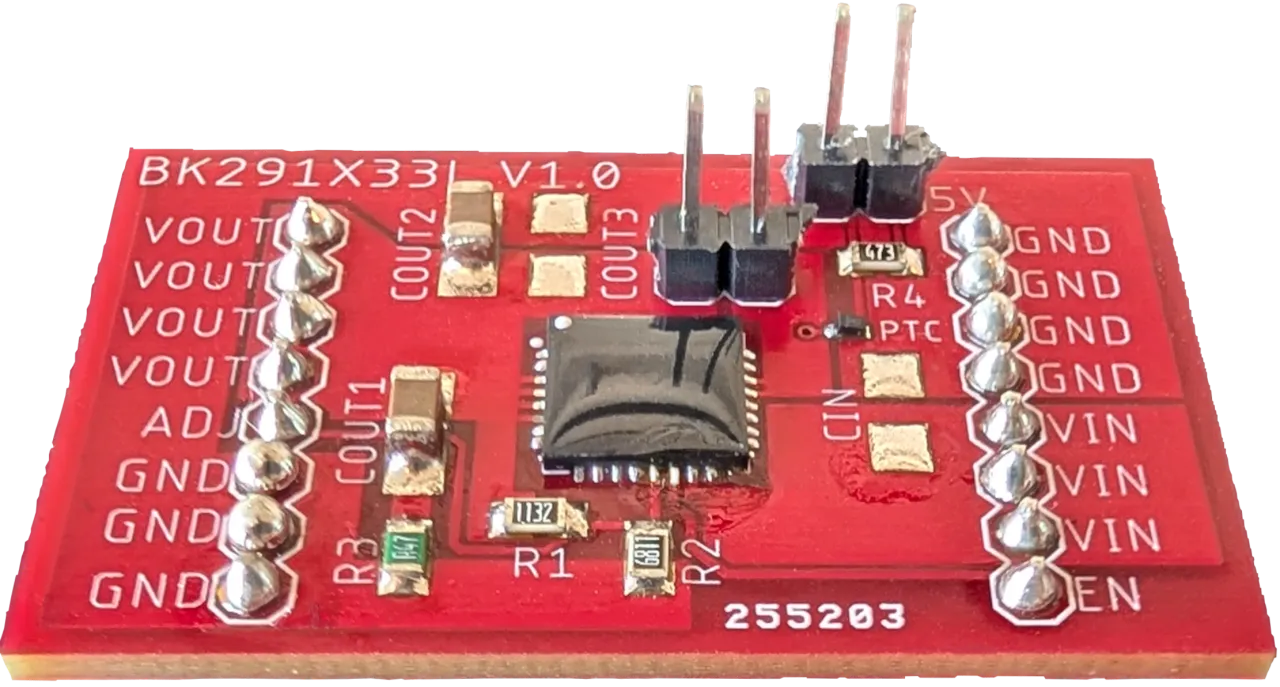
| BK291D33L | Buck | 1.2 – 4 | 26 | VOUT + 1.4 | 1000 | 65 | 245 | 200 | QFN-32 · 7 mm | MIC29152 | Spotlight |
| BK291D33V | Buck | 1.2 – 4 | 26 | VOUT + 2.8 (M) VOUT + 5.5 (H) | 1000 | 65 | 245 | 200 | QFN-32 · 7 mm | MIC29152 | Spotlight |
| BK291D50E | Buck | 1.2 – 5 | 26 | VOUT + 7.0 | 1000 | 65 | 350 | 200 | QFN-32 · 7 mm | MIC29152 | Spotlight |
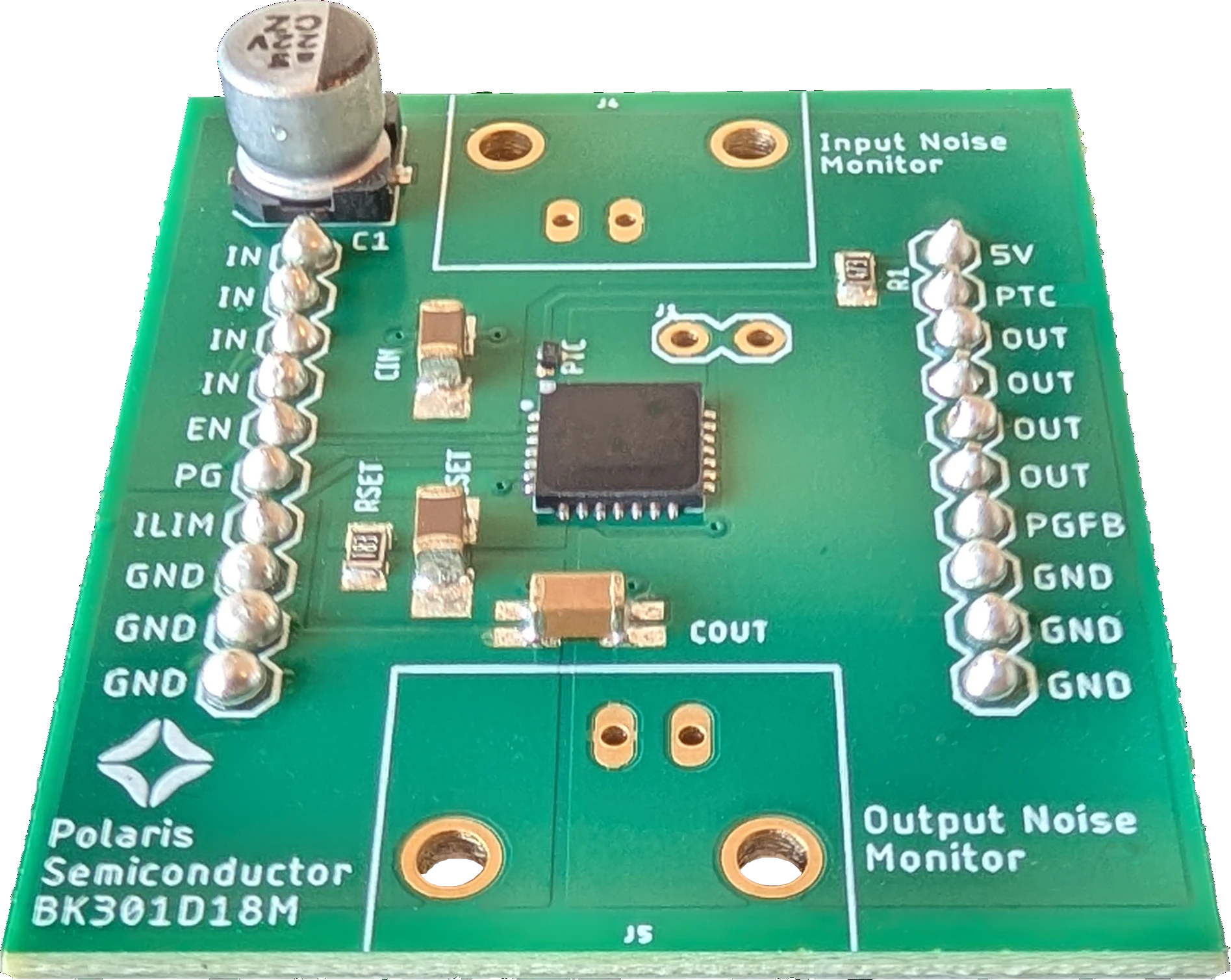
| BK301D18V | Buck | 0 – 2 | 15 | VOUT + 1.4 (L) VOUT + 2.8 (M) | 500 | >100 | <1 | 200 | QFN-28 · 6 mm | LT3045 | Spotlight |
| BK301D33L | Buck | 0 – 4 | 15 | VOUT + 1.4 | 500 | >100 | <1 | 200 | QFN-32 · 7 mm | LT3045 | Spotlight |
| BK301D33V | Buck | 0 – 4 | 15 | VOUT + 2.8 (M) VOUT + 5.5 (H) | 500 | >100 | <1 | 200 | QFN-32 · 7 mm | LT3045 | Spotlight |
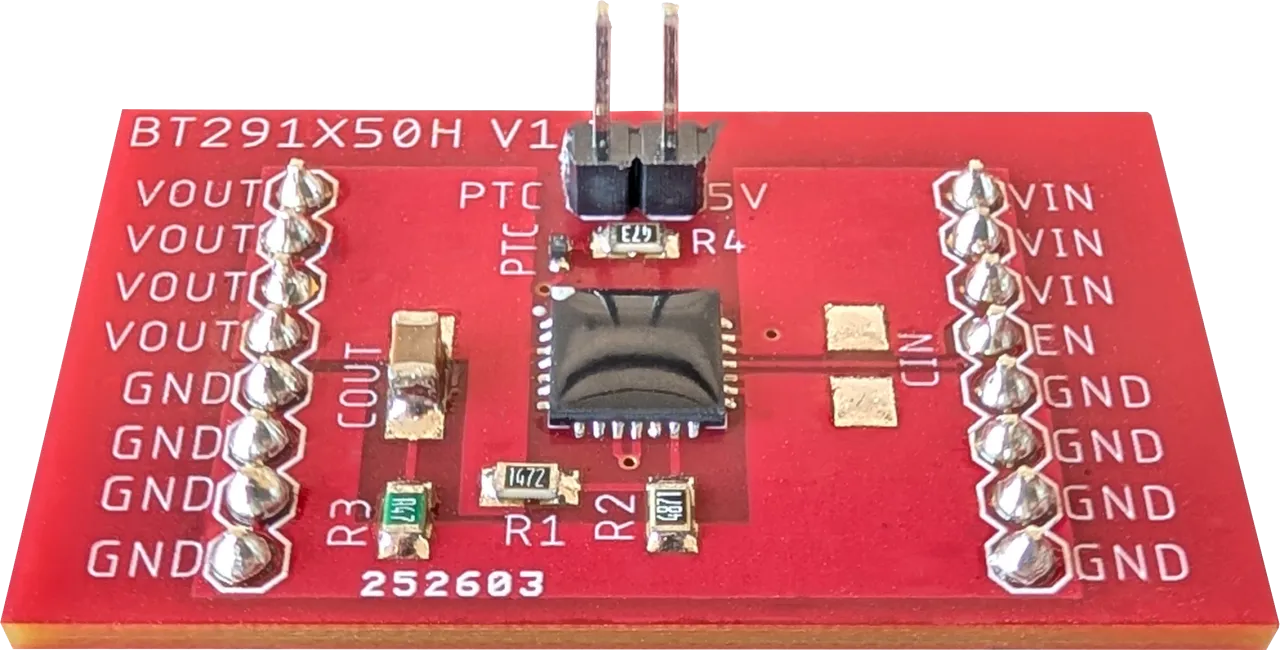
| BK301D50H | Buck | 0 – 6 | 15 | VOUT + 4.1 | 500 | >100 | <1 | 200 | QFN-32 · 7 mm | LT3045 | Spotlight |
| BK300D50E | Buck | 0 – 5 | 15 | VOUT + 7.0 | 500 | >100 | <1 | 200 | QFN-32 · 7 mm | LT3045 | Spotlight |
| BT291D50M | Boost | up to 5 | 12 | 3.1 | 350 | 60 | 200 | 200 | QFN-28 · 6 mm | MIC29152 | Spotlight |
- All parts listed here are under development and device specifications are subject to change.
- Minimum input voltage applies in optocoupler-enhanced mode at Iout = 0.1 A. Every device can also operate as a conventional low-dropout linear regulator with lower VIN via the pin connections to the device.
- RMS output noise is specified over 10 Hz – 100 kHz.
- Part numbers ending in “V” select between two input-voltage ranges via board-level pin connections.
- TID ratings denote device-level radiation tolerance. The BK19’s RH1965 LDO core additionally carries QML-V radiation hardness assurance (200 krad(Si) at a 50 rad/s dose rate).
- For the boost part (BT291D50M), at input voltages above the 5 V output the device continues to regulate.
- All Polaris ELR parts can be easily paralleled for higher output currents, lower output noise and improved thermal dissipation. Example schematics, BoM and PCB layout guidelines are described in application note PSAN003.
Reading a Polaris part number
Output-voltage code (buck): 18 ⇒ outputs up to 2 V · 33 ⇒ up to 4 V · 50 ⇒ up to 5 V (up to 6 V on BK301D50H). Outputs are adjustable: BK19 and BK29 devices down to 1.2 V, BK30 devices down to 0 V — see the selection table for each part's exact range.
Input-voltage range: L lowest · M medium · H high · E extended — IDs ending in V select between two ranges via board-level pin connections. Every device also runs as a conventional LDO by shorting two pins ("LDO mode").
Boost (BT) parts share the same grammar but regulate up to 5 V — see the BT29 series page for output behavior.
A board for every part
All products are available on evaluation boards, ready to drop into your test setup. Request one with your samples.
Datasheets & SPICE models
Full datasheets and SPICE models are available on request — ask with your sample request or talk to an engineer.
Don't see your spec?
We also offer custom configurations — different LDO cores, output ranges, and input windows. Tell us what you need.
Ready to design it in?
Request evaluation samples, detailed datasheets, and SPICE models — an engineer answers, not a sales funnel.